26 mars 2012

TRIATHLON PHYSIOLOGY FOR DUMMIES AND THE TENDENCY TOWARD THE MEAN


Sixth part
Let us go back to the oldies.  Now a day it is very difficult to do research because there are not enough sponsors paying for.  Everything needs to be useful to get sponsors for research.  “Good old times” are gone.
The research done helps us to have a better planning.  Chris Carmichael gives some guidelines regarding recovery.  They are empirical but very practical.  The Lance Armstrong Performance Program.  Rodale, USA. 2000 (91).

I said in the previous parts in the blog and in this series.  One needs to practice cadence, technique and speed steadily until one is able to do the cadence and speed she/he would like to have for competition; rest two minutes and try again. Five minutes is very difficult to sustain without lowering speed, but that would be the objective; rest two minutes and try again.  Once the speed drops, stop and rest two minutes. Do eight of them or until you accomplish the distance you want to compete in. Eight repetitions would be the gold standard to run a 10k at a good speed.  If you are beginner, it takes around three years of training intensively to accomplish the strength to start training at the speed we would like to compete with.  Life is very specific; one lives according to what one practices.  The same thing for training, one’s performance depends on the quality of one’s practice.
Another oldie: Biology of Sport, Vol. 20 No2, 2003. PLASMA GROWTH HORMONE, CORTISOL AND TESTOSTERONE RESPONSES TO REPEATED AND INTERMITTENT ERGOMETER EXERCISE AT DIFFERENT PEDALLING RATES
In the conclusion it may be stated that the rate/speed of performed work influences the hormonal response through the increase of cortisol and growth hormone concentrations alongside the similar level of the acid – alkali blood balance disturbances during work with higher pedaling rate. The smaller hormonal response on standard loads (constant power and time of the effort) is conditioned by the high physical capacity. Smaller disturbances of the acid – base blood balance correspond with the smaller response of stress hormones which in our research were: the growth hormone and cortisol. The direction and size of hormonal changes may present the criterion of better adaptation to sport effort/training and evaluation of the growth of so called “sport condition”.
Another oldie: Journal of Strength and Conditioning Research, 1996, 10(4),256-262. Influence of Resistance Exercise Volume on Serum Growth Hormone and Cortisol Concentrations in Women.
Our observations support what has previously been reported with regard to the role of specific exercise variables: heavy-resistance exercise protocols using high volume (3 sets), moderate to heavy loads (8- to 10-RM at 70 to 85% of 1-RM resistance), and short rest periods «1 min) augment the magnitude of the GH response in both men and women (4, 20, 22). A less significant and/ or no GH response has been reported with exercise configurations of lower volume, lower intensity, and/ or longer rest periods (20, 22-24, 31, 34, 36). The degree of variance in physiological activity between the exercise protocols may be attributed to such factors as duration of training session, acid-base shifts, anaerobic work performance, circulation of associated sympathetic hormones, age, or muscle mass used; all of these have been reported to affect serum hormone and lactate values(4, 5, 9, 18,20, 31).

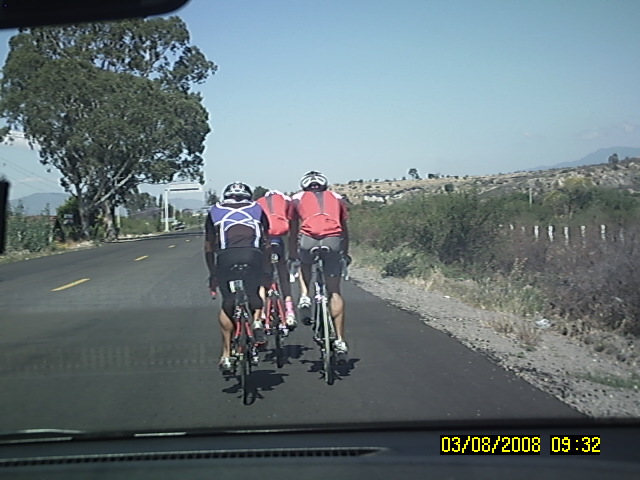
I hope it is useful! The photo belongs to Ramón Jiménez.  It looks the way I see training.  What to do during recovery days?  Do not increase your cortisol.  If one eats right during easy works out it is just fine.  Remember Tinley.

Please go back to read parts 1,2,3,4,5.

22 mars 2012

TRIATHLON PHYSIOLOGY FOR DUMMIES AND THE TENDENCY TOWARD THE MEAN

FIFTH PART
I was planning five chapters to deal with triathlon physiology.  I will extend myself with different titles.  I already used different titles in previous writings.
Scott Tinley, a man that started triathlon training and went beyond the limits of training in the 80’s to improve performance, gives a good recounting of what could happen if one does not follow a plan to improve.  This was an interview at the end of his career.  Inside triathlon magazine, volume 15, June: 2000:
“You have alluded that there have been a lot things going wrong with your body in the past four years.  What have they been?
 I think I compromise in number of different systems in my body—my pituitary-adrenal axis and my hormonal system. And my emotional state—because of depleted neurotransmitters. 
What are some of the signs of these depleted states?
When you exercise cortisol increases because is a parasympathetic stimulator –fight or flight.  You want your cortisol to go up…My cortisol level was already elevated.  A normal person is 8 to 9 –mine was 13 at rest…We did tests at the Olympic Training Center and found that my cortisol production dropped during an eight-mile-run (20).  
Our memory can help us or kill us.  But let us go back to basics.  I copied this research from:
Wilmore, J.H., Costill, D.L., & Kenney, W.L. (2007). Physiology of sport and exercise. Champaign, IL: Human Kinetics.
We start with questions about what we see from this serious research.  How long the cortisol is going to be up to hit the body once again to produce GH?  It depends on the intensity of the training and the athlete´s level of training.  But six hour is enough for most of the high performance athletes.  This way we can produce more GH with another hit to the body.  Some research tell us not to wait so long, because the longer you wait after a hard work out the higher the cortisol increases.  We have not done cortisol testing on our athletes.  We have empirical research based on performance.  Remember, it does no matter what you produce as hormone if your technique and specifically your cadence is not adequate for what you expect as performance. “Practice as you compete and compete as you practice.”
Exercise is a stress, and cortisol, often called the "stress hormone" is produced in response to stress. The longer you exercise, the more cortisol you produce, and the production is increased the longer you rest between exercises. Keeping your rest periods short can limit your body's ability to produce cortisol. One of the functions of cortisol is to break down proteins for amino acids, and large concentrations of cortisol will scavenge muscle tissue for any amino acids your body may require…
Your production of growth hormone can be increased with exercise, but again only with heavy exercise. Rest periods play a larger role in the stimulation of growth hormone, so by keeping your volume and intensity high and your rest periods under 90 seconds, you can increase your production of this hormone.

Read more: http://www.livestrong.com/article/390281-what-hormone-does-exercising-produce/#ixzz1psywC4Xc


I would not keep kicking a dead horse but knowing consequences and how to improve training is important, and cortisol places an important part in it.  As I said previously: Do not forget that there are many variables in training and we should know most of the them to have an edge over competitors.

19 mars 2012

TRIATHLON PHYSIOLOGY FOR DUMMIES AND THE TENDENCY TOWARD THE MEAN

    Fourth part: cortisol and growth hormone.
Many things have been written about it.  But let´s see what we know:
All patients taking mineralocorticoid, meaning hormones derived from cholesterol and produced by adrenal glands, have the same effect on the body; except they all have an emphasis on one characteristic.  They all retain fluids by absorbing sodium, metabolize proteins and possess anti-inflammatory properties.  We have names for the three different end products: cortisol, aldosterone and testosterone.  As one can see, naming can deceive the person who thinks. I prefer converting the verb (action) in substantive; like aspirin-like-effect when encounter with drugs that affect the body temperature, pain and the “inflammation” of the body.  But aspirin-like-effect drugs do not derive from cholesterol.  As one knows testosterone is used as a doping hormone because it improves healing, strength and muscle-fat percentage and distribution.  Cortisol can be used and I believe nobody has tried aldosterone; but it can have some doping effect depending on the dosage and the type of sport.  I do not advocate doping; I am trying to explain the effects of “steroid” on the body.  This is a graphic from Wikipedia regarding mineralocorticoids:
Steroidogenesis, showing mineralocorticoids in ellipse at top right. Note that it is not a strictly bounded group, but a continuum of structures with increasing mineralocorticoid effect, with the primary example aldosterone at top.
What to do with this knowledge, how to apply it?  All these hormones are in a cybernetic balance.  Experimenting with hormones can be done while training.  Instead of dividing the training in “zones,” I will use the hormones as the markers for training using a cybernetic model.
When stressing the body the muscles suffer change according to the amount of Growth Hormone (GH) released by the body, which also depends on the amount of cortisol released by the body.  At a certain limit cortisol inhibits the release of growth hormone but cortisol is necessary to release GH.  Too much cortisol knocks out the growth hormone production and as a consequence the changes we are looking for do not take place.  That is why the stress should be according to our objectives and level of training.  If one wants to run 30 minutes-10k; one needs to increase the time on the stress zone progressively until being able to run five minutes at the same speed, in the scale of 1-10, 7-8 effort makes the trick.  Keeping technique and cadence is very important (please, read previous 1, 2 and 3 parts); as I said, training is very specific and the improvements made would be according to the training cadence and technique.   At the same time neurological training should take place.  Neurons do not use fat or proteins as fuels.  They depend on glucose. In order to keep firing as a “plug” for the muscles, neurons need training which can be gotten at the regular muscular training, but one needs specific training to increase the firing rate if one pursues a different performance level.  How can the neurons keep firing if one does no train neurons to fire at high speed for a long period of time?  If one´s pulse is high or low depends on the neurological training, and this is the main player in our speed, not so much the muscles.  When one trains and the pulse remains low even when we try to increase it by increasing speed; it means that the neurons are tired, and the muscles could be o.k.
Every muscular change takes two weeks approximately to be in place.  It is a gene induction what we do and it needs recovery and nutrition to happen.  Depending where one is when starting--regarding the working load, increasing it slowly follows keeping recovery and nutrition at the best. It takes at least 10 years to create a junior champion, keeping the best recovery and nutrition in place and 15% increment of the work load per year.  That is why talent has to do more with perseverance than to physical attributes.

15 mars 2012

TRIATHLON PHYSIOLOGY FOR DUMMIES AND THE TENDENCY TOWARD THE MEAN


Third part
I read a beautiful summary about training.  Teaching physiology requires a practical language and empirical research.  The theories do not matter if we do not have something tangible, something real, because we want real results and answers.  Josh Horowitz, in www.pezcycling.com was brave enough to distance himself from many things and many people.  As human beings we tend to have monuments of our heroes, I have in my house the mill that my father used for mining to search for gold.  He was living his dream, searching for gold; it was his time.  It has nothing to do with alchemy; it was plain work on milling stones to obtain gold, more than 50 years ago.  I also look for gold, but “my milling stones” are athletes to obtain gold.  I kept his mill at the home I inherited as a monument. The monument reminds me that we can do it, but at the same time limit us; the swimming pool is shorter.
Santo Domingo Oaxaca
One interval per workout.
High Spin (H.S.) – This is an interval that you will do almost every week for the entire three months and it is the only interval that crosses the different training cycles so that tells you how important it is. The High Spin interval, otherwise known as No Load Revving is done with almost no tension on the pedals. So a flat road in your easiest gear is perfectly fine. If you’ve never done one before, start at 100 rpm. You can inch it up until you start rocking a bit in the saddle and then back it off just a notch. The target cadence is going to be 120 to 140 rpm.
These are zone 2 intervals but don’t worry if your heart rate goes all the way to zone 4 when you start. The body adapts incredibly quickly to these. You’ll notice that your heart rate will drop dramatically after the first few sessions, even at a higher cadence and speed. Because of the high cadence, you can actually do these on your easy recovery days or your endurance days. During this first phase we will limit these to 10 minutes, as we don’t want your speed to peak too early….
 Also, keeping a nice steady pedal stroke with a still upper body is key. This is going to be the same pedal stroke that when sped up to over 100 rpm is going to give you peak cycling performance. If it’s not close to perfect at 50 rpm then it’s going to be a real mess when you get up to 130.….

It is very difficult to grow old knowing that many things we do in cycling are not the best for our performance because of the monuments we have to keep.  Jacques Lacan said: “Love is the reason we invented the unconscious.”  That is why Freud threw him from the Olympus of Psychiatry.  But it is the best we learned from our teachers and we are too obedient to challenge everything.  Josh has the best review I found in the web.  Practice spinning and increase your power without decreasing the rpm and not the opposite.  Start from 105 rpm and add force steadily and not the opposite.  This should be called reverse periodization in the full sense.  There is no way to patent it but it will be the way of training few years from now.  Forget about the energy systems.  The body adapts to anything as long as you give nutrients and recovery.  Good for Josh.

12 mars 2012

TRIATHLON PHYSIOLOGY FOR DUMMIES AND THE TENDENCY TOWARD THE MEAN

Second part
I will continue with cadence in swimming.  I spoke about cadence running and biking.  Is there a cadence in swimming? Of course, when we see Michael Phelps swimming 100 meters his rpm is around 71 per minute.  20 strokes less than the ones leading the peloton in an ITU race for the same distance at the same pace.  Michael phelps has at least 50 centimeters more of span length compared to any triathlete.  The swimmers that get to semifinals in the Olympics usually take 8 or 10 more strokes than the ones reaching the finals for the 100 meters free.  Popov used to do 400 meters reps in 4:30 with almost the same length-per-stroke than swimming the 100 meters competition.
Atridf photo
I thank Gennadi Touretski for his teaching and for being a great teacher.  When we met, I was sitting on his desk at Tenero, Switzerland.  I did not know it was his desk until he came in and ask me who I was.  I explained to him my ignorance about the place and its rules, and above all my ignorance regarding who he was; although I had read about him.  I told him that I was watching his swimmers.  When he told me who he was, I said to him that I wanted to learn from him.  I stayed with him for two weeks, watching and listening.  Once he looked at my watch and told me to buy a watch to check cadence.  I did not know they existed.  I bought one and started to count cadence with him.  He introduced me to checking cadence with the new watch.  When in Switzerland, I saw Cancellara winning the Paris-Roubaix and I was surprised he was averaging above 100 rpm.  Later on, I saw Wiggins averaging above a 100 to win a podium at the TT in the Worlds; I was using my new watch.  Gennadi introduced me to the training of the great Alexander Popov and, of course, to measure cadence with the watch to check quality indirectly.

So, we need a cadence of 62-65 rpm to be with the peloton when swimming in an ITU race for the males; the better swimmers take less strokes. One can check that with a watch. Touretski said to me during those two weeks, “I do not use paddles to keep the rpm up; in order to keep the speed of the arms.” Interestingly, Paul Bergen, a former American and Canadian Olympic swimming head coach who we invited to help us with our team, told me: “the Mexican female who has the record for 800 meters cannot do a single chin up,” he was intrigued by it because Inge de Bruijn trained doing chin ups when she was trained by him.  I wasn't surprised, because I knew that you need more speed than force to move your arms rapidly.  There are two main forces in swimming: the propulsive and the resistance.  They opposed each other.  The resistance should decrease and the propulsive should increase to improve your length per stroke and speed.  That is why we need technique so much when swimming.  Although, it is like cycling, the faster one goes the higher the resistance; except that water is even worse compared to air regarding resistance by friction.  The more strokes one takes; the more resistance one produces. That is why the best swimmer do not produce much propulsive force and/or strokes. The resistance in cycling is done by air and the resistance swimming is done mainly by increasing the number of strokes, due to the viscosity and turbulence of the fluid when stroking.  At the end, you have to swim like Phelps, but with a higher rpm if you are not 6 feet 5 inches, without loosing your length-per-stroke. “Whites can jump,” it is a matter of practice and intelligence.  Watch Nate Robinson.

I will continue with chapter three on TRIATHLON PHYSIOLOGY FOR DUMMIES AND THE TENDENCY TOWARD THE MEAN. In the meantime, I will give you a homework based on the definition of wilkipedia on rev limiters:

A rev limiter is a device fitted to an internal combustion engine to restrict its maximum rotational speed. This is usually carried out to prevent damage to the engine, however sometimes these devices are fitted to prevent an engine reaching the point at which it develops maximum power. This may be useful in a driving school car or similar, or utilised in systems preventing Valet parking operatives from joy-riding in high-performance vehicles placed in their charge.

I hope you are competing and not riding a school car.  Human-made machines give us a better understanding of what I am talking about.  DO NOT GIVE UP YOUR POWER, IMPROVE YOUR CADENCE. What do you really want?


    11 mars 2012

    TRIATHLON PHYSIOLOGY FOR DUMMIES AND THE TENDENCY TOWARD THE MEAN

    I have been avoiding this issue, but I need to explain everything to my athletes; everything that we human beings know regarding physiology and triathlon.  This knowledge is applied physiology and experimentation in one or two subjects.  Kazdin writes:

    I do not get to the point of the Nobel Prize winner, Barry James Marshall, on self-experimentation, but we have done self-experimentation.  I will not follow a protocol but I will divide arbitrarily in five chapters.  This would be the first one.
    Why one subject experimentation? A tendency toward the mean will be present most of the time because the amount of variables present when testing a very small cohort, 20-30 or 40 subjects, does not give a statistical power; “science does not proof, just proves.”  The experimentation is useful when we know the different variables.  For instants, I have seen graphics which do not belong to me. It is a testing of the Mexican Federation, where increasing the pacing (decreasing the time per kilometer) when increasing the cadence, correlates with a better outcome while competing running, compared to increasing the time flying (increasing the stride length).  When you see the outcome it is difficult to make something out of it if you do not have a good idea about the variables, but knowing the background it is easier.  This is the strongest reason why the tendency toward the mean exists, or as I would say:  “chance plays a major role when we do not have an intervention for each variable.”  Improving technique is an intervention.  That is why Einstein said: "God does not play dice with the universe."
    Let’s continue with the example of cadence.  It is said that increasing cadence increases oxygen consumption, reason why some coaches advocate low cadence.  This looks like a paradox because we do not take into consideration the type of fibers use and the neurological training needed to run or to cycle at a high cadence, above 220 running and above 105rpm cycling.  When we do a metabolic test, the more oxygen we use the fitter we are.  Increasing cadence augments oxygen consumption because the heart, lungs and legs use more oxygen.  The advantage is the type of fibers used while cycling or running, oxygen consuming fibers, the ones that fatigue until they die, or if there is an oxygen debt.  If we decrease cadence, e.g. to 180 running or 80rpm cycling keeping the same speed, involvement of the other fibers that do not use so much oxygen takes place and fatigue sits in or bonking is a consequence.  What to do with high oxygen consumption in the case of high cadence? Eat more in order to continue exercising.  How much? For a 70kg athlete, 450 calories per hour is the goal, in order to avoid the bonking.  Of course, we need to have a neurological training and anaerobic training to face the competition at a high cadence which I will explain later.  Empirical observations we have with Lance Armstrong and the athletes we have trained.  In some we have a before and an after when changing the cadence, a one subject experimentation.

    4 mars 2012

    A Tendency Toward The Mean and Richard Bach´s Risk

    Yesterday we had a competition in Valle de Bravo.  The FMTRI gave a spot for juniors to compete in the North American Championship.  They gave other two spots without informing the selection.  As usual, they have this kind of behavior to choose their competitors that belong to the High Performance National Institute.  Our athletes competed against the elites in a sprint triathlon; the first junior was granted the spot.   Our junior (17-year-old) obtained the spot given; he was fourth against the elite field composed by the Mexican Team and the Brazilian Team. Two Brazilians obtained the first places followed by a Mexican who passed our athlete in the final sprint.  Our team worked as always, as a team, and perhaps nobody knew it.  You can check our athletes’ blogs to know about tactics, they were the performers.
    Who in the hell is Richard Bach?  There is a well-known motivational film used with our athletes, “Jonathan Seagull.” Richard Bach is the author.  I am always careful to show the film because young people want to perform in a very special way.  Unfortunately, they do not have enough knowledge/experience to do it on their own without supervision; everything could become a catastrophe without knowledge.  The point I make clear watching the film is: “if you do not look for the right people to learn from, you become a fool because there is a tendency toward the mean.”
    This is a statistical observation: “if you mixed two different groups regarding a characteristic, the groups tend to look the same after certain amount of time.” Wikipedia says the following. “In statistics, regression toward the mean (also known as regression to the mean) is the phenomenon that if a variable is extreme on its first measurement, it will tend to be closer to the average on a second measurement, and—a fact that may superficially seem paradoxical—if it is extreme on a second measurement, will tend to have been closer to the average on the first measurement.[1][2][3] To avoid making wrong inferences, the possibility of regression toward the mean must be considered when designing experiments and interpreting experimental, survey, and other empirical data in the physical, life, behavioral and social sciences.”  In other words, we can become as our rival if we share time competing.  This could be good or bad depending on the kind of rival we have.  The same happens in the creation of a team, we depend on teammates more than anything.  Please read the information on Wikipedia.
    I am not a fan of statistics but explaining the phenomenon of the tendency toward the mean is fantasying; but it is scary just to think about it.  It just exists and we take providence regarding this matter. Our athletes selectively compete and teammates are selected according to what we want as a team.  Our concept of talent is not physical; it has to do with perseverance and education to learn like “Jonathan Seagull.”  That is why we chose this film.