7 juin 2014

Triathlon World Cup versus Continental Cup


There is a huge difference between a Continental Cup and a World Cup.  The main difference is more than 150 watts average riding the bicycle.  That is the difference in power between Alistair Brownlee and our young elite competitors in a 40k ride of an Olympic distance triathlon.  We thank Felipe Barraza for posting values regarding the Continental Cup at Dallas (2014):
Resumen
Distancia:
24.64 mi
Tiempo:
57:10
Velocidad media:
25.9 mph
Altura ganada:
686 ft
Calorías:
635 C
Temperatura media:
89.9 °F
Detalles
Tiempo
Tiempo:
57:10
Tiempo en movimiento:
57:09
Elapsed Time:
1:40:07

Velocidad media:
25.9 mph
Avg Moving Speed:
25.9 mph
Velocidad máxima:
37.5 mph
Speed
Pace
Altura
Altura ganada:
686 ft
Altura perdida:
689 ft
Altura mínima:
348 ft
Altura máxima:
394 ft
Potencia
Potencia media:
187 W
Potencia máxima:
1,034 W
Max Avg Power (20 min):
200 W
Equilibrio izquierda/derecha:
47/53 %
Normalized Power (NP):
209 W
Intensity Factor (IF):
1.045
Training Stress Score (TSS):
102.8
Configuración de la potencia de umbral funcional (FTP):
200 W
Work:
638 kJ
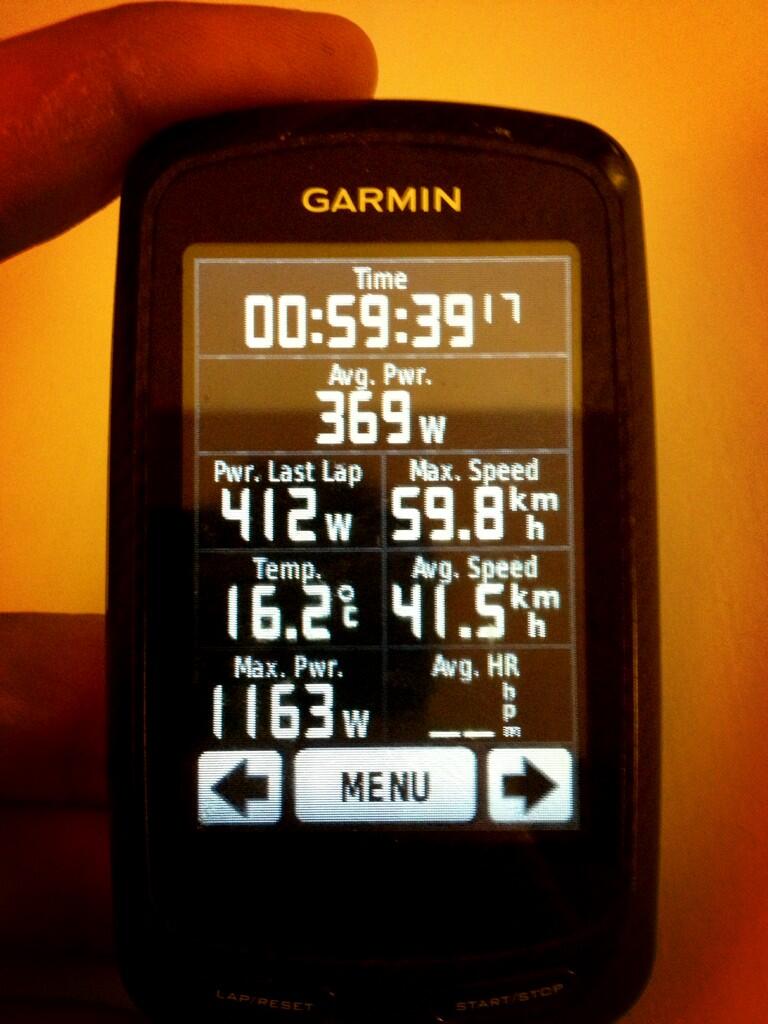
The Dallas’ power output has nothing to do with what is produced in a World Cup when Brownlee and Gómez are pulling the leading peloton.  We have shown several measures posted by Jan Frodeno that shows his average during a race, it is well above 350 watts even though he is not leading the first peloton which is going faster.
22 avr. 2013
We will try to answer the above question.  Jan Frodeno has giving us interesting information regarding the effort done during the last two competitions.  For Frodeno, the effort was the same at San Diego and Auckland (changed a wheel and kept with the first pack).  370 watts average during the 40k bike, meaning he had the same power in a hilly course as in the flat course.


Frodeno's power Auckland


The bike was harder in San Diego compared to Auckland for Frodeno! Different training protocols are required for the two courses.  Jan is a heavy guy for a triathlete and going up hills requires extra watts, he used the same watts without lifting his weight in San Diego; meaning that he was giving more work to the ones behind him (Jan was one of the ones pushing the pace at the chasing packs).  370 watts is the limit for the majority of the triathletes competing in these races to have a “wet run.”  Whoever kept hidden longer in the second pack led by Frodeno was able to run faster at the end.  The ones that stayed with Brownlee were not able to run because they just kept “closing the gaps;” and as a consequence, they could not do a “wet run.”  Please see previous post:
11 mars 2013
Wet Run II and Triathlon
Of course, this strategy works for second, third place, but not for the champion: Brownlee.


What does it mean?  Our athletes cannot run after the bike when increasing the bike work during the race because their Functional Capacity is around 200.  We had had a 20k time trial of a female triathlete averaging 188 watts on a flat surface at a pace of 38k/hr.  Felipe was drafting in the peloton and his average speed was 41k/hr.  Weight on a flat surface is not important as we can see on the formula below:

It takes years to improve biking power, equal to the time needed for running below 30min the 10k or swimming following the first pack.  We are at the level of Continental Cups with our triathletes.  Laurent Vidal has published similar values as the ones posted by Frodeno.  The Functional Capacity of the Brownlees and Gómez in triathlon is around 370 watts.  Mola and Murray 330 based on the competitive ability, on a flat surface.

http://www.oocities.org/mdetting/sports/power_eqn2.gif
The Power Calculator
Principio del formulario
Your weight (in kg)


Bicycle weight (in kg)
Bicycle velocity (in km/h)
Headwind velocity (in km/h)
Air density (in kg/m3)
Effective frontal area (in m2)
Coefficient of rolling resistance
Road Slope (in %)
Gravitation (in m/s2)
Required Total Power (in Watt)
- Power to fight air resistance
- Power to fight gravity

2 juin 2014

Triathlon Evolution


I was listening to Guennadi Touretski while watching world class triathletes.  He just told me:  “They are average swimmers.”  We still are average swimmers as triathletes and some even worse than average.  Biking and running have improved several notches but the likes as Andy Potts are gone.  Triathletes need to start as good runners and average swimmers to have a chance to be on the international scene 10 years later.

I was a runner in College and remember the female master record holder for 10,000 meters, Carmen Troncoso, when she was 22 years of age.  She ran the 800 meters in 2:22 and the 10,000 meters above 40 minutes.  At the age of 40, she was running below 34 minutes the 10k as the following article stated:
Born in New York City, Ayala-Troncoso grew up in Mexico, where she was a sprinter and long jumper at Monterey College. After suffering a sprained ankle during her senior year, she began running distances for rehabilitation and gradually developed into a distance runner, recording track times of 15:50 for 5,000m and 33:21 for 10,000m during her peak years. By finishing third in the 1993 national cross country championships, she represented the U. S. in the 1994 world cross country championships in Budapest; she also ran the 2000 world games in Portugal. At 41, she clocked 16:05.68 in the Olympic trials 5,000m.
It takes that long to improve if we have perseverance.  Even though she was slow running, her technique was good enough to improve running times with mileage and intensity.  The same has been the case with Gómez and the Brownlees.  Alistair was running the 10k in 34 minutes at the age of 17, nothing great.  Five years later, he was below 30 after swimming and biking in a triathlon.  Gómez was just below 31 minutes running for the 10k when he started winning in triathlon.  He has improved his running time for 10k by approximately 2 minutes since he started competing.

Malcolm Brown has made empirical research very helpful to know the reason why triathletes as the Brownlees have evolved the way they have done it.  Brown says nothing new for the ones that have been around observing and experimenting with teams and athletes:
1)   Family and working environment make the different to have successful athletes.
2)   Talent is not about the physical attributes, but the degree of education and perseverance.
Please watch the video mentioned above which helps to understand the evolution of triathlon.

21 mai 2014

Triathlon and Yokohama World Cup


Soccer has changed over the last 20 years.  The footballer is more athletic and muscular than before; it is necessary to intimidate applying force when playing against technical rivals as Brazil.  Barcelona Club continued to play differently, applying more technique than force, they lost everything this year. Triathlon was different this last time in Yokohama.  A new variable played a big role, kind of a loose cannon, Tom Davidson pulled the chased group to reach the first one knowing that he was not able to run (35 minutes for the 10k).  Did he have a plan? He never tried to escape from the rest; he just kept the tempo at 50 km/hr.  Murray thanked Davidson for the ride.  Mola was able to get second while Murray was third coming more than 40 seconds after the swim.  The ones that worked for the first group were defeated except for Gómez.  What a job champ?  Chapeau!  This has been a kiwi problem; I mentioned this in a previous post.
28 oct. 2012
What follows in this paragraph could look like another matter but it is not. I saw on TV that a free trade between NZ and China was signed. Reaction from friends were present immediately, the USA wants to have a military base there to stop the spreading of China without control; otherwise New Zealand will be punished somehow.  It is presented as the only way to survive in this new world for New Zealand, according to the TV program.  NZ is conscious about the human rights in China, and that the USA sees this as a threat to its way of living and thinking.  New Zealanders feel they need the trade with China to continue with their way of living.  The TV program mentioned the slogan about New Zealand, “Many friends, no enemies.” China signed the first free trade with the West, experimenting with the Kiwis.  That is the way Crocodile Dundee would go Kiwis; watch out, you know how he ended up.

Next stop will be interesting to see.  How the Brownlees, Gómez and the rest will overcome this loose cannon.  Is Davidson getting pay by Mola and Murray for his job?  He should get pay. Hopefully the first pack comes up with something more interesting than just sitting in the peloton as the female competitors do.  It is becoming boring when they just sit without any other strategy but a wet run.